A monthly log of what shipped on the platform — new capabilities, improvements, and the infrastructure work behind them.
Latest July 2026
Cadence Monthly
Audience Customers & partners
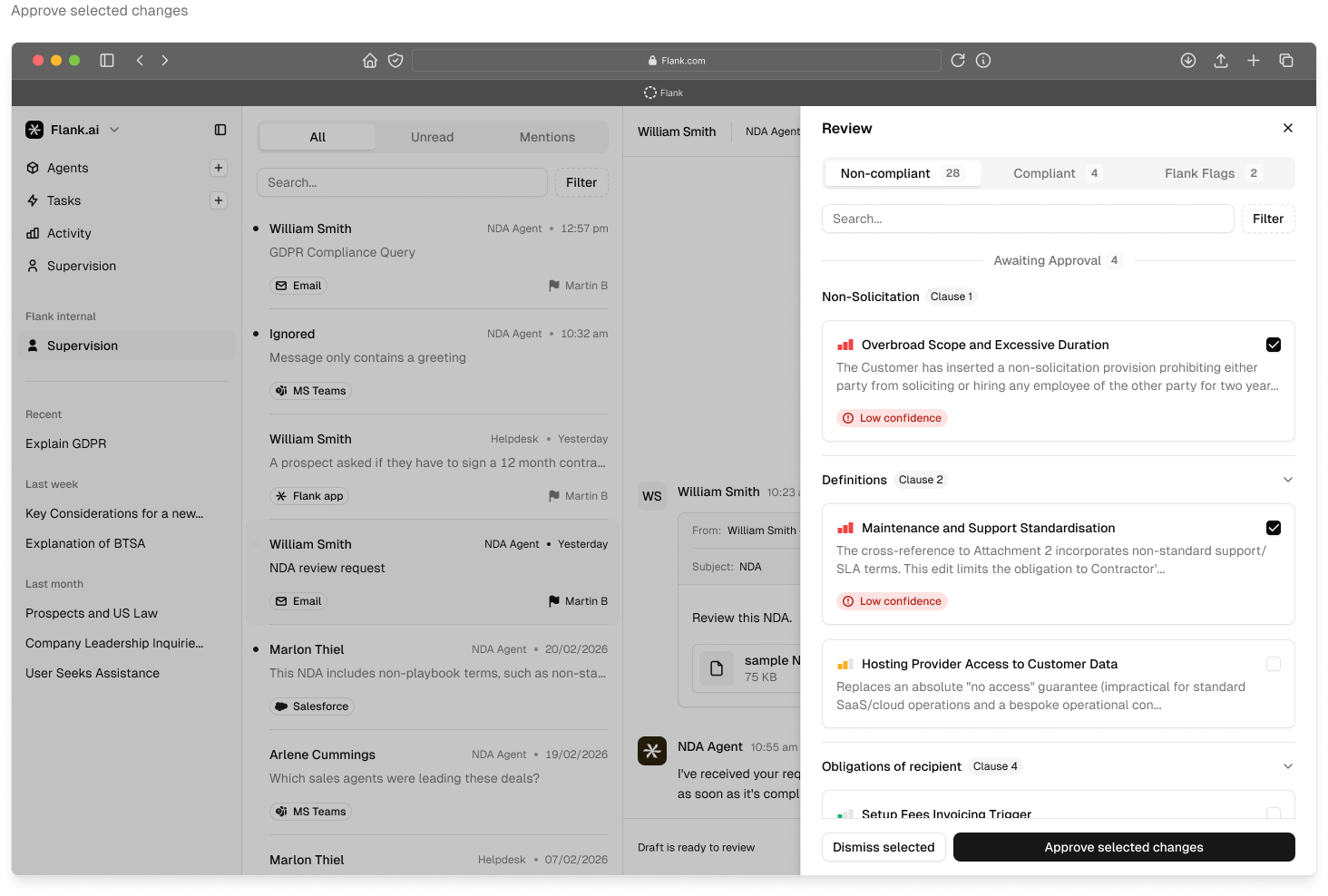
You no longer read the agent's whole output. It confirms everything your playbook already settles, and holds back what needs you — the high-risk provisions, and the calls it is not sure of.
New
Check what matters, not everything
The agent works through the contract against your playbook and resolves what it can. Every item shows how it reasoned and which rule it applied, with a link through to that rule. Up to 90% of routine reviews resolve without senior counsel. Run supervision on everything, by exception, or not at all.
Confirmed — up to 90%
Held
A routine review: the agent confirms what the playbook settles; the rest is held for your decision.
Confirmed
Compliant clauses, matched fallbacks, and the redlines the agent applied on your behalf, all shown as done. Where the playbook settles the point the agent makes the change itself, including substantive ones, and anything it has done can be reverted.
Held
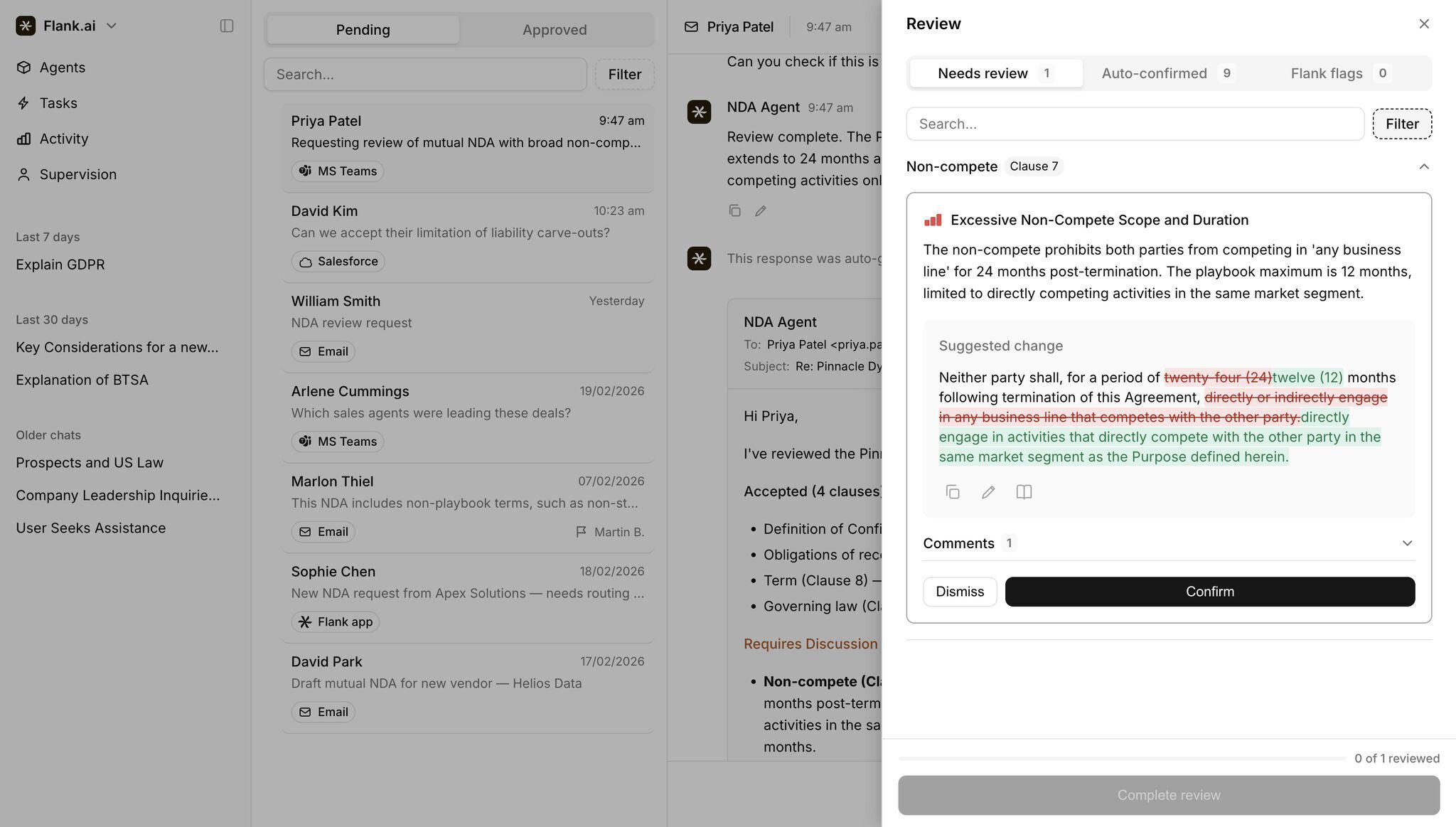
Two things reach you. The high-risk provisions your playbook says to escalate — a cap above a threshold, any AI clause — and the calls the agent is not confident in, whether in its reading or in how to fix what it found.
Decided
Apply the suggestion, edit the wording directly in tracked changes, or tell the agent what you want in plain English — "accept two years", "make it 25%" — and it redrafts.
The review panel on a routine NDA: nine items auto-confirmed, one held — an over-broad non-compete — with the agent's reasoning and the suggested redline ready to confirm.
Improved
Sharper redlines
Rather than rewriting a clause wholesale, the agent proposes the smallest set of edits that brings it in line with your playbook, drafts the exact replacement wording, and presents it as tracked changes. The agent now also checks its own redlines visually before handing the document over, catching changes that did not land as intended.
The standards that govern the work are now yours to set — the playbook the agent reviews against, and the rules that decide where every request goes.
New
Build the playbook the agent works from
Your review standard usually lives in a Word document and a few people's heads. Import it and Flank extracts your positions and structures them into a playbook the agent works from, or build one from scratch. Playbooks cover both your own paper and the counterparty's.
Preferred and fallback positions
What you expect to see in a clause, and the alternatives you have pre-approved for when you cannot get it.
Unacceptable deviations
The language you never accept. The agent rejects it and counters with your wording.
Escalate if
The high-risk conditions that need a named person to sign off — a cap above a threshold, an AI clause, anything outside the positions you have set.
Improved
Routing rules you write yourself
Routing is now yours to configure. Describe a category of work in plain language and send it where it belongs: to a specific agent, to a named person, or to an external address. Rules can be written in intake or straight from the inbox.
"NDAs on our paper, standard terms"
NDA agent
"Anything touching data protection"
Privacy counsel
"Supplier onboarding paperwork"
procurement@
Every request the front door picks up now lands in a single view — what came in, what happened to it, and what is still waiting on you.
New
A single view of every request
Legal finally has one place to see everything it is being asked for: every request the front door picks up, across channels and senders, in one filterable list. Three things you can now do from that single view.
See
Every request in one list, internal and external senders, filterable by type, channel, and status.
Follow
Open any request to see what the front door did and why — handled by an agent, routed to a person, or waiting on you.
Act
When something needs a lawyer, review the agent's draft, edit, and send, or step into the full thread to take it on directly.
Every channel lands in one queue — email, MS Teams, Salesforce, Helpdesk, the Flank app — with the full thread and the agent's work one click away.
New
The data behind the demand
For the first time, Flank captures every request coming into legal in a consistent, queryable form — what was asked, through which channel, what kind of work, the urgency, and how it was handled. It is the record legal has never had, and the foundation for seeing which work types dominate, where requests stall, and what is routine enough to hand to an agent.
Flank now sits across the channels legal teams already use — shared inbox, Teams, Slack, the desk-side ask — and consolidates them into a single front door.
New
Front door for all legal requests
The agent picks up every inbound request and decides what to do with it: forward to the right person on your team, or execute the work itself. Three jobs run on every request that lands.
Filter
Emails that don't need action are ignored. Nothing irrelevant reaches your team.
Label
Every request gets a status in Outlook — in progress, resolved, or filtered out — so the team sees the state of each one without leaving their email client.
Route
Requests are categorised by topic and sent where they belong. NDA requests reach the contracts team. Procurement questions go to procurement. Work outside the agent's scope is routed to a lawyer. No manual forwarding.
Heavier execution at scale, self-service for ops teams, and a sharper eye on counterparty changes.
Infrastructure
Production-scale long-running workflows
Multi-step contract reviews, agreement generation, and playbook-driven redlining now hold steady across hundreds of pages and thousands of daily documents. Once a request is picked up, it stays picked up — no dropped work, no silent failures, no lost progress.
Improved
Self-serve agent configuration
Designated users can now create new agents, assign task types, and manage configurations directly in the platform. Adding an agent for a new work type is a ten-minute task, not a support request.
New
Untracked change detection in contract review
When a counterparty returns a document with edits made outside of track changes, the agent catches every deviation and flags it for your team rather than blocking the review.
On the roadmap
The same review surface for every kind of work
Third-party review is where focused supervision starts, not where it ends. Coming next: the same experience for defending your own paper and for the agent's drafting — one surface where you approve what matters and let the rest through.
Subscribe
The Intake
Weekly briefings on what's actually changing in legal AI — the market shifts, regulatory moves, and structural questions that matter for enterprise legal teams.
Enterprise legal teams use Flank to handle high-volume contracting end-to-end — NDAs, MSA redlines, procurement, triage. Agents that know your templates, terms, and escalation rules.
 The review panel on a routine NDA: nine items auto-confirmed, one held — an over-broad non-compete — with the agent's reasoning and the suggested redline ready to confirm.